

The role has been live for four months. The candidates aren’t the problem.
A procurement manager role in Northern Ireland shouldn’t take four months to fill.
And yet.
I see it constantly. The role has been live since January. Three agencies have had it. There’s a shortlist that’s not really a shortlist. The hiring manager is starting to wonder if the right person simply doesn’t exist.
They do exist. That’s almost never the problem.
The problem is almost always somewhere in the process that ran before anyone approached a single candidate. And because the process happens behind the scenes, out of sight of the client, the candidate pool ends up taking the blame for a failure that was never theirs to own.
Why the brief is almost always wrong before the search begins
When a role stalls in Northern Ireland, the explanation is usually one of three things, sometimes all three at once.
The salary was set months ago against an internal pay band that was already behind the market when it was approved. Nobody has checked it against what roles at the same level are actually offering right now. The figure in the brief is a budget line, not a market position.
The job specification was written by someone who listed everything the ideal candidate might ever need to do across a three-year period. It reads like four roles and pays like one. Candidates read it, run a quick mental calculation and decide they do not fit, or do not want to, and move on.
And by the time the third agency has sent the same pool of candidates who have already declined elsewhere, the market has quietly formed a view about this role. Word travels fast in a small professional community like Northern Ireland. A role that has been around too long starts to carry a reputation. Not a good one.
None of this is the candidates’ fault.
The incentive that is quietly wrecking your search
The agencies running these searches are not incompetent. They’re incentivised incorrectly.
When a recruiter only gets paid if someone accepts an offer, the entire structure of the engagement pushes toward speed. Send CVs quickly. Move to the next instruction if this one stalls. Don’t spend three hours mapping the market, benchmarking the salary or challenging a brief that is structurally wrong before the search has even started. There’s no fee in that work. So it doesn’t get done.
No one is being dishonest. The model simply doesn’t reward the work that would fix the problem. It rewards the work that looks like progress – calls made, CVs sent, interviews arranged – while the actual issue goes unaddressed week after week.
This isn’t a character failing. It’s a commercial logic problem. And it produces the same result every time: a search that runs for months, generates management time and frustration in roughly equal measure, and eventually either fills with the wrong person or doesn’t fill at all.
What a £6,500 salary gap actually looks like in a live search
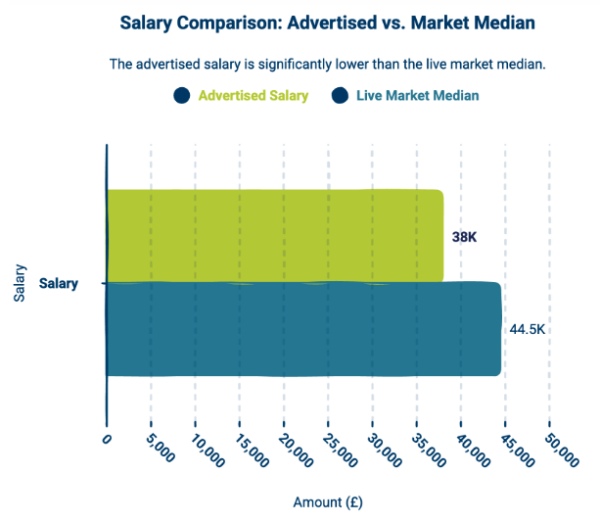
A real example from a recent NI procurement search. Role had been active for 12 weeks across two agencies before the brief was reviewed.
Last month I started working on a search where the client wanted a procurement manager at £38,000. The live market median for that profile in Northern Ireland was £44,500.
The client had no idea. Neither did the two agencies who had been running it for twelve weeks without producing a credible shortlist. They had been sending candidates, taking calls and writing polite emails about the market being challenging.
Not one of them had opened a spreadsheet and shown the client that the salary was the problem.
That’s a 17% gap between what the role was offering and what the right candidate expects to earn. In a market as tight as Northern Ireland procurement, that gap doesn’t produce a slow search. It produces no search. The candidates worth having looked at the number and moved on in under three minutes. The candidates who stayed in the process were those with fewer options, not better fit.
The market wasn’t short of procurement managers. The brief was short of market intelligence.
The search that ran for four weeks after a twelve-week failure
We reset the brief. We benchmarked the salary against live data and presented that data to the hiring manager directly, with comparable roles, current offer letters where available and a clear view of what the position was competing against. We rewrote the specification around what the role actually needed in the first six months rather than what someone might theoretically need over three years.
Then we had an honest conversation about what the market could deliver at the adjusted budget, what it couldn’t, and what a realistic timeline looked like.
The search ran for four weeks after that. Shortlist of three strong candidates. Offer accepted without a counter-offer, because the proposition had been clearly communicated from the first conversation rather than negotiated at the end of a process that had already worn everyone down.
The candidates were there the whole time.
This is why I challenge briefs before beginning to work on a search. It’s not to be difficult, or to add time to a process. Almost all employers want to move quickly. But a search built on unrealistic parameters doesn’t produce a slow result; it produces no result at all. And three months later, everyone is looking at the candidate pool when they should have been looking at the brief.
If a procurement or supply chain role you’re managing has been live for more than eight weeks without a credible shortlist, I’d genuinely like to know what reason you have been given for the lack of traction.
Kelly Jennings is the Director of Kelly Jennings & Associates, a specialist search consultancy focused exclusively on procurement and supply chain recruitment across Northern Ireland, Republic of Ireland and Great Britain.